Most visitors see Giza and assume they have seen Egypt's pyramids.
They have seen the conclusion. Saqqara and Dahshur tell the story of how the ancient Egyptians got there — the experiments, the failures, the refinements that span 150 years of architectural evolution before the Great Pyramid was even begun.
This tour covers all three sites in sequence. By the end of the day, the Giza Pyramids look different — not just as monuments, but as the culmination of something.
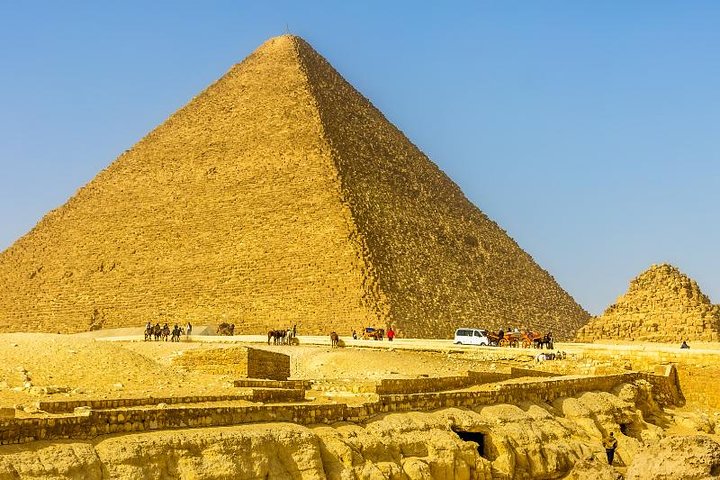
Where the story ends. The three pyramids of Khufu, Khafre, and Menkaure — built over three generations, representing the absolute peak of pyramid construction. Your guide explains why Egypt never built anything like this again.
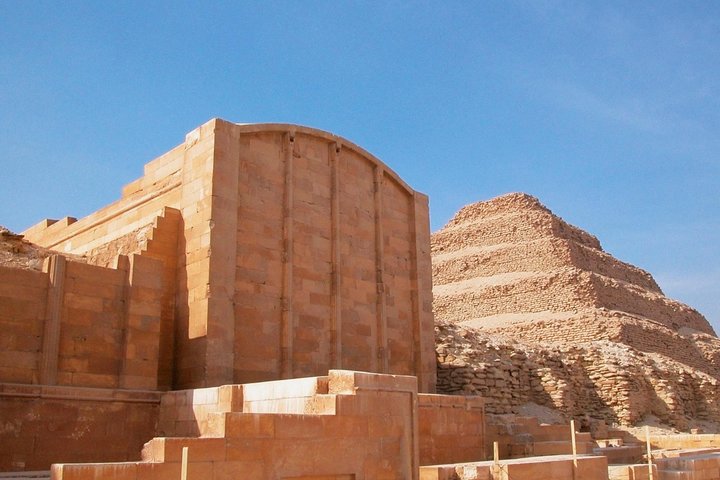
Where it began. The Step Pyramid of Djoser — built approximately 2650 BC, roughly 70 years before the Great Pyramid — is the first monumental stone structure in human history. The surrounding necropolis contains mastabas, tombs, and funerary temples that predate Giza entirely. This is the original.
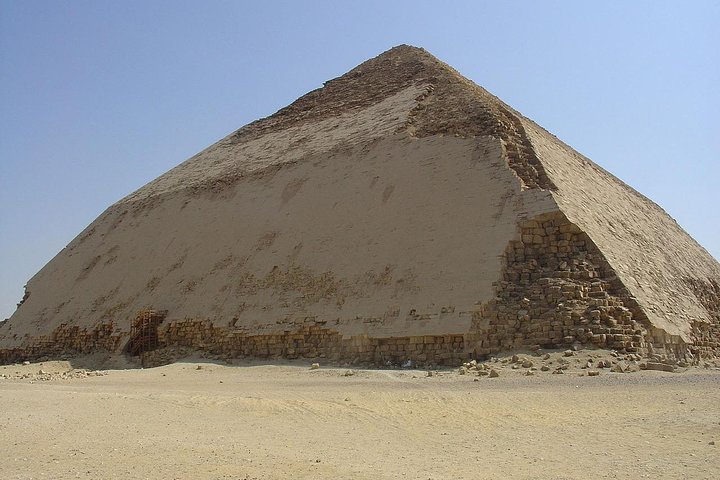
The experiments in between. The Bent Pyramid and the Red Pyramid of Pharaoh Sneferu — Khufu's father — show the moment when Egyptian builders were solving the geometric problem of a true smooth-sided pyramid. The Bent Pyramid changes angle mid-construction because the original angle proved structurally unstable. The Red Pyramid, completed shortly after, got it right. Khufu's architects at Giza inherited that solution.
✦ Standing at the Bent Pyramid and then looking south toward the Red Pyramid — both visible from the same spot — you can see the moment of architectural problem-solving frozen in stone. Your guide will frame it precisely, and it is one of the most intellectually satisfying moments available on any Egypt tour.
This is a driving day as well as a walking day — the three sites are spread across 60km south of Cairo. Your private vehicle connects them comfortably. Lunch is taken between Saqqara and Dahshur.
Recommend: comfortable shoes, a hat, and sunscreen. The sites are largely open and exposed.
Is Saqqara crowded?
Significantly less than Giza. The plateau at Saqqara is one of Egypt's least crowded major sites, given its historical significance — most tour groups go directly to Giza. This is a genuine advantage of this itinerary.
Can I enter the Bent Pyramid?
Yes — a small section of the Bent Pyramid's interior corridor has been open to visitors since 2019. Entry is included if available on your visit date. Your guide will confirm before the tour.
Will I be pressured to buy anything?
No. This is a private tour. We do not include commission-based stops and your guide will not redirect the itinerary for shopping.
Can the pacing or order be adjusted?
Yes. This is private — the schedule adapts to you. If you want to spend longer at one site or skip something, tell your guide.
Is this suitable for travelers arriving from a long flight?
We recommend scheduling your first full tour after at least one night of sleep in Egypt. If you are booking for the arrival day, we can discuss a gentler start time.
Pickup & Timing: Your guide contacts you the evening before your tour via WhatsApp to reconfirm the exact pickup time and your hotel details. Pickup is from the lobby of any hotel in Cairo or Giza (Luxor or Aswan for southern tours). If you're staying in an Airbnb or non-hotel accommodation, share your location pin when booking so your driver can find you easily.
What You'll Pay On-Site: All entry fees listed in the itinerary are included. If you choose optional upgrades during the tour — such as entering the Tutankhamun tomb, the Seti I tomb, or the Great Pyramid interior — these are paid on-site by credit or debit card. Your guide will advise whether each upgrade is worthwhile before you decide. Cash is no longer accepted at most major archaeological sites in Egypt.
Weather & Sun Egypt is hot and dry for most of the year. From October to March, daytime temperatures in Cairo are comfortable (18–25°C / 65–77°F), but mornings can be cool. From April to September, expect 35–45°C (95–113°F) at open-air sites. The Giza Plateau, Valley of the Kings, and Karnak have almost no shade. Your guide schedules site visits to avoid the worst midday heat, but sun protection is essential regardless of season.
Dress Code: Dress comfortably and modestly. At mosques (Al-Hussein, Al-Azhar, Alabaster Mosque), shoulders and knees must be covered — this applies to all genders. At archaeological sites, there is no dress code, but lightweight long sleeves protect against the sun better than sunscreen alone. Comfortable closed-toe shoes with grip are essential — sites involve walking on sand, uneven stone, and rough terrain.
Photography: Photography is permitted at most outdoor archaeological sites. Inside tombs (Valley of the Kings), photography is generally prohibited unless you purchase a separate photography ticket. Inside the Grand Egyptian Museum, photography rules vary by gallery — your guide advises on the day. Drone photography at all archaeological sites requires permits that are extremely difficult to obtain. Do not fly a drone without confirmed authorization.
Payments & Currency Egypt's currency is the Egyptian Pound (EGP). Most tourist-facing businesses accept credit/debit cards and USD. Your guide and driver accept tips in EGP, USD, or EUR. ATMs are widely available in Cairo, Luxor, and Aswan. Recommended tipping: $5–10 per person for your guide on a half-day tour, $10–15 on a full day. $3–5 for your driver.
Health & Safety: Drink only bottled water (provided on your tour). Tap water in Egypt is not safe for tourists. Carry any personal medications you need — pharmacies are available but may not stock specific brands. Apply sunscreen before departure, not on-site — you'll be in the sun within minutes of arriving at most sites. Travel insurance is required for all tours and is not provided by Pyramids Land.
Cultural Notes: Egyptians are genuinely welcoming. "Shukran" (thank you) and "Salaam alaikum" (peace be upon you) go a long way. At tourist sites, you may be approached by local vendors or people offering unsolicited help (leading you to a viewpoint, taking your photo). A polite "la, shukran" (no, thank you) works. Your guide manages these interactions so you don't have to.
Starting from
Pay On Tour
Most visitors see Giza and assume they have seen Egypt's pyramids.
They have seen the conclusion. Saqqara and Dahshur tell the story of how the ancient Egyptians got there — the experiments, the failures, the refinements that span 150 years of architectural evolution before the Great Pyramid was even begun.
This tour covers all three sites in sequence. By the end of the day, the Giza Pyramids look different — not just as monuments, but as the culmination of something.
Where the story ends. The three pyramids of Khufu, Khafre, and Menkaure — built over three generations, representing the absolute peak of pyramid construction. Your guide explains why Egypt never built anything like this again.
Where it began. The Step Pyramid of Djoser — built approximately 2650 BC, roughly 70 years before the Great Pyramid — is the first monumental stone structure in human history. The surrounding necropolis contains mastabas, tombs, and funerary temples that predate Giza entirely. This is the original.
The experiments in between. The Bent Pyramid and the Red Pyramid of Pharaoh Sneferu — Khufu's father — show the moment when Egyptian builders were solving the geometric problem of a true smooth-sided pyramid. The Bent Pyramid changes angle mid-construction because the original angle proved structurally unstable. The Red Pyramid, completed shortly after, got it right. Khufu's architects at Giza inherited that solution.
✦ Standing at the Bent Pyramid and then looking south toward the Red Pyramid — both visible from the same spot — you can see the moment of architectural problem-solving frozen in stone. Your guide will frame it precisely, and it is one of the most intellectually satisfying moments available on any Egypt tour.
This is a driving day as well as a walking day — the three sites are spread across 60km south of Cairo. Your private vehicle connects them comfortably. Lunch is taken between Saqqara and Dahshur.
Recommend: comfortable shoes, a hat, and sunscreen. The sites are largely open and exposed.
Is Saqqara crowded?
Significantly less than Giza. The plateau at Saqqara is one of Egypt's least crowded major sites, given its historical significance — most tour groups go directly to Giza. This is a genuine advantage of this itinerary.
Can I enter the Bent Pyramid?
Yes — a small section of the Bent Pyramid's interior corridor has been open to visitors since 2019. Entry is included if available on your visit date. Your guide will confirm before the tour.
Will I be pressured to buy anything?
No. This is a private tour. We do not include commission-based stops and your guide will not redirect the itinerary for shopping.
Can the pacing or order be adjusted?
Yes. This is private — the schedule adapts to you. If you want to spend longer at one site or skip something, tell your guide.
Is this suitable for travelers arriving from a long flight?
We recommend scheduling your first full tour after at least one night of sleep in Egypt. If you are booking for the arrival day, we can discuss a gentler start time.
Pickup & Timing: Your guide contacts you the evening before your tour via WhatsApp to reconfirm the exact pickup time and your hotel details. Pickup is from the lobby of any hotel in Cairo or Giza (Luxor or Aswan for southern tours). If you're staying in an Airbnb or non-hotel accommodation, share your location pin when booking so your driver can find you easily.
What You'll Pay On-Site: All entry fees listed in the itinerary are included. If you choose optional upgrades during the tour — such as entering the Tutankhamun tomb, the Seti I tomb, or the Great Pyramid interior — these are paid on-site by credit or debit card. Your guide will advise whether each upgrade is worthwhile before you decide. Cash is no longer accepted at most major archaeological sites in Egypt.
Weather & Sun Egypt is hot and dry for most of the year. From October to March, daytime temperatures in Cairo are comfortable (18–25°C / 65–77°F), but mornings can be cool. From April to September, expect 35–45°C (95–113°F) at open-air sites. The Giza Plateau, Valley of the Kings, and Karnak have almost no shade. Your guide schedules site visits to avoid the worst midday heat, but sun protection is essential regardless of season.
Dress Code: Dress comfortably and modestly. At mosques (Al-Hussein, Al-Azhar, Alabaster Mosque), shoulders and knees must be covered — this applies to all genders. At archaeological sites, there is no dress code, but lightweight long sleeves protect against the sun better than sunscreen alone. Comfortable closed-toe shoes with grip are essential — sites involve walking on sand, uneven stone, and rough terrain.
Photography: Photography is permitted at most outdoor archaeological sites. Inside tombs (Valley of the Kings), photography is generally prohibited unless you purchase a separate photography ticket. Inside the Grand Egyptian Museum, photography rules vary by gallery — your guide advises on the day. Drone photography at all archaeological sites requires permits that are extremely difficult to obtain. Do not fly a drone without confirmed authorization.
Payments & Currency Egypt's currency is the Egyptian Pound (EGP). Most tourist-facing businesses accept credit/debit cards and USD. Your guide and driver accept tips in EGP, USD, or EUR. ATMs are widely available in Cairo, Luxor, and Aswan. Recommended tipping: $5–10 per person for your guide on a half-day tour, $10–15 on a full day. $3–5 for your driver.
Health & Safety: Drink only bottled water (provided on your tour). Tap water in Egypt is not safe for tourists. Carry any personal medications you need — pharmacies are available but may not stock specific brands. Apply sunscreen before departure, not on-site — you'll be in the sun within minutes of arriving at most sites. Travel insurance is required for all tours and is not provided by Pyramids Land.
Cultural Notes: Egyptians are genuinely welcoming. "Shukran" (thank you) and "Salaam alaikum" (peace be upon you) go a long way. At tourist sites, you may be approached by local vendors or people offering unsolicited help (leading you to a viewpoint, taking your photo). A polite "la, shukran" (no, thank you) works. Your guide manages these interactions so you don't have to.
We use cookies in compliance with legal regulations to improve your shopping experience. You can find detailed information here. Privacy Policy and Protection of Personal Data






 Loading